Ashe County Livery – Ashe County Livery blog – Page 2
🚐 Book luxury transportation in NC's High Country — (336) 484-1350 | Book Online

Author: Ashe County Livery

  • Woolly Worm Festival Transportation: Getting to Banner Elk Without the Parking Headache

    Woolly Worm Festival Transportation: Getting to Banner Elk Without the Parking Headache

    Woolly Worm Festival Transportation: Getting to Banner Elk Without the Parking Headache

    Woolly Worm Festival Transportation is the smartest way to enjoy Banner Elk’s October weekend without circling for a parking spot or making long walks from distant lots.

    The Woolly Worm Festival draws crowds from Boone, Blowing Rock, Sugar Mountain and beyond. If you’re planning a visit, here are practical ways to get there, where to ask your driver to drop you off, and tips to move between events without wasting time hunting for parking.

    Why consider private chauffeured transportation for the weekend

    Festival weekends mean limited downtown spaces, temporary no-parking zones and narrow mountain streets. A private ride—whether a luxury SUV or an executive shuttle van—drops your group close to the action, stays on call for returns, and eliminates the hassle of remote long-term lots. It also keeps late-night returns safe after a full day of events and live music.

    Best approach roads and drop-off spots

    Banner Elk is reachable from several scenic corridors. Consider these approaches and where to ask to be let out to minimize walking:

    • From Boone/Blowing Rock via US-321: Ask for a drop-off near downtown Banner Elk to avoid the uphill walk from the community lots.
    • From Sugar Mountain or Beech Mountain via NC-105: Request a drop-off closer to the festival green to avoid the congested Ridge Street intersections.
    • Scenic approaches via the Blue Ridge Parkway: If you want the view, plan for extra time—your driver can time the scenic pull-offs so you arrive relaxed and on schedule.

    Where drivers can park and wait

    Permanent downtown parking is limited during the festival, but drivers can usually wait in nearby lots a short drive from the green or stand by on less-congested side streets. If you’re traveling with a group, coordinate a single return time: one quick pickup is faster than chasing multiple return windows.

    Timing tips that save you hours

    • Arrive early: If you want front-row access to contests or craft vendors, aim for opening hours. Early arrival also avoids the mid-afternoon traffic spike.
    • Plan your exit: Pick a pickup time slightly after the event’s stated end to account for final announcements and crowds dispersing.
    • Staggered returns: For mixed groups, schedule two short return windows—one right after peak and one later for slower walkers—so no one feels rushed.

    Where to meet when parking is full

    If downtown is full, a few practical meet points work well for speedy pickups:

    • A roadside pull-off on NC-105 or US-321 a block or two from the festival center.
    • Nearby commercial lots that allow waiting by appointment—ask your driver about lawful spots that minimize walking.
    • Designated event overflow areas communicated by festival staff; a private drive can stage there and shuttle small groups directly.

    Packing and accessibility reminders

    • Bring layers—late-October mountain afternoons can shift quickly from warm sun to chilly shade.
    • If mobility is a concern, tell your chauffeur ahead of time so they can choose the closest legal drop-off and assist with short walks.
    • Reserve a single vehicle for groups who want to stay together; it’s easier to coordinate mealtimes and returns that way.

    Pair your festival visit with nearby destinations

    Extend your day with a scenic drive or a stop at Sugar Mountain Resort, Beech Mountain viewpoints or a picnic along the Blue Ridge Parkway. If you’re making a longer weekend of it, private transport makes hopping between towns—Boone, Blowing Rock and downtown Banner Elk—effortless while you take in fall color. For more on planning fall drives and seeing peak foliage in the High Country, read Fall Foliage Season in the NC High Country: A Transportation Guide for Leaf-Peepers or check peak-season airport transfer tips in Fall Break Airport Transfer NC: CLT to Boone in October Peak-Season Tips.

    Late-night returns and safety

    Festival evenings can run late. Book a return window with your chauffeur and avoid overcrowded public lots after dark. A private ride ensures your group leaves together and gets back to your lodging—whether you’ve stayed in Banner Elk, Sugar Mountain or Boone—without the stress of navigating full parking areas or icy mountain roads if the temperature drops.

    How to reserve and what to tell your chauffeur

    When you reserve, share your expected arrival time, number of passengers, mobility needs and preferred pickup location (street name or recognizable landmark). Dates are locked by a nonrefundable deposit, so plan your times before booking and confirm the pickup/drop-off points in advance.

    Ready to avoid the parking headache? Book now or call (336) 484-1350 to arrange Woolly Worm Festival transportation into Banner Elk. Your chauffeur will handle routing on US-321, NC-105 or scenic Blue Ridge approaches so you can focus on the fun.

    Enjoy the festival—predictable, comfortable arrivals and departures make the whole weekend more relaxing.
  • They See a Two-Hour Ride. We See a Five-Hour Job.

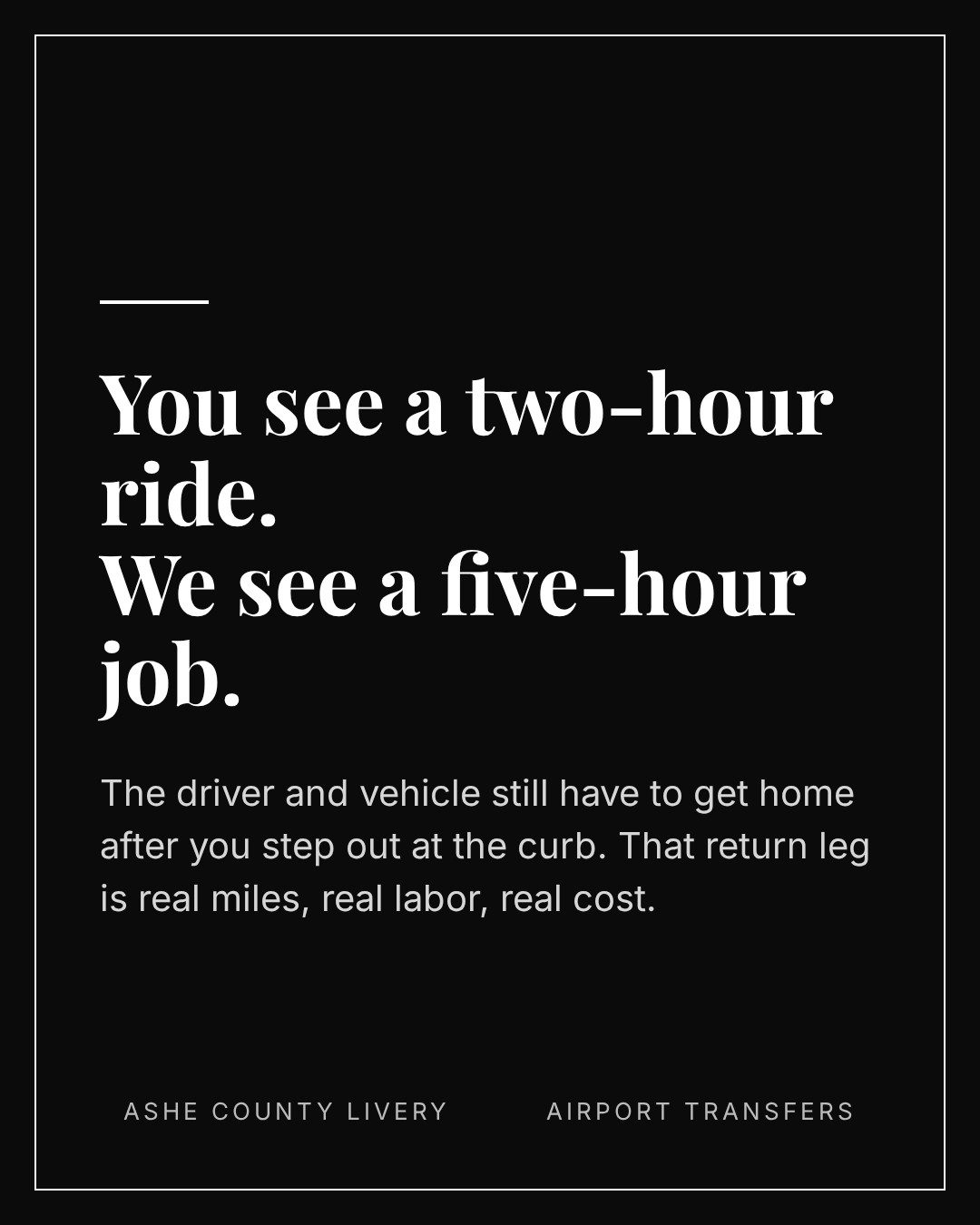
    They See a Two-Hour Ride. We See a Five-Hour Job.

    When you book a private airport transfer from the NC High Country, you see a two-hour ride: we pick you up at your door, and a couple of hours later you’re at the terminal.

    When we see that same booking, we see a four- or five-hour job.

    That gap is the biggest reason long-distance airport transfers cost what they do, and it’s the part almost nobody thinks about.

    The driver doesn’t disappear at the curb

    You step out, grab your bags and walk into the terminal. Your part of the trip is over. Ours is only half done.

    The vehicle and the professional driver still have to get back to the mountains. That return leg is the same distance, the same fuel, the same wear on the vehicle, and the same hours of a driver’s workday as the leg you rode in. It’s just empty.

    Airport pickups work the same way in reverse. Before you ever land, the driver has already made the long run down to meet you at the curb.

    What that return leg really costs

    Every mile of an airport transfer, loaded or empty, carries costs that don’t go away:

    • Labor. A professional driver’s time, door to door and back again
    • Fuel. Both directions, every time
    • Maintenance. Tires, brakes, oil and service intervals come around faster on a vehicle doing highway runs
    • Commercial insurance. Carried on every mile, not only the miles with a passenger aboard
    • Depreciation. Every round trip adds hundreds of miles to the odometer

    No one else pays for that return leg. The trip that created it is the only trip that can cover it.

    Why distance changes everything

    A 30-minute city airport run and a mountain-to-airport transfer aren’t the same trip at different addresses. They’re different jobs. Airport transfer pricing follows distance and time, not zip code. A run that takes a driver out of the market for most of a day costs more than one that has the driver back in an hour, anywhere in the country. We compared this to Florida routes of the same length in What a High Country Airport Transfer Costs vs. Florida.

    What you get for it

    Because the whole job is built into the price, your side of it stays simple. You don’t park, you don’t haul luggage through a deck, you don’t drive unfamiliar roads, and you don’t make the long drive home after a late flight. You get in, and we handle the rest, including the half of the trip you never see.

    So before you judge the fare, remember:

    Don’t compare our fare to zero. Compare it to what the trip actually costs you to do yourself, then decide what the convenience is worth.

    For the full breakdown, read Don’t Compare Our Fare to Zero: What a Private Airport Transfer Really Costs, or request your airport transfer.

    Traveling on a budget?

    The Blue Ridge Shared Ride Connection matches High Country travelers headed to the same airport on the same day, so you can split the cost of a professionally driven private ride. Built for App State and Lees-McRae students, and open to anyone 18+ in the High Country.

  • First Frost Weddings: Transportation Tips for Late-October Mountain Ceremonies

    First Frost Weddings: Transportation Tips for Late-October Mountain Ceremonies

    First Frost Weddings: an overview

    First Frost Weddings bring a special stillness to late October wedding NC mountains, but frosty mornings and dropping temperatures require careful transportation planning. Couples who account for roads like US-321 and NC-105, guest comfort at pick-up, and timing for photos on the Blue Ridge Parkway have smoother days and happier guests.

    Why frost changes the plan

    Cold snaps in Boone, Blowing Rock, Banner Elk, and West Jefferson can create thin ice on shady roads and slick patches on venue driveways. Even when the sun comes out, early-morning frost can delay arrivals and sap guests’ morale if they’re not prepared. Expect slower travel, extra time needed for loading, and a preference among guests to avoid long walks across frozen lawns.

    Local road considerations

    • US-321 between Blowing Rock and Boone can be narrow and curvy; allow extra time for cautious driving in frosty conditions.
    • NC-105 up toward Banner Elk climbs quickly; plan pickup times so you avoid summit fog and residual ice.
    • Blue Ridge Parkway photo runs are gorgeous at first light but can be icy in shaded sections—schedule these later in the morning if possible.

    Before the ceremony: prep that saves time

    Confirm pickup locations that are easy to find and easy to park. For hotels in downtown Boone or Blowing Rock, choose a lobby entrance or designated curbside spot to avoid guests standing on cold granite or grass. If you’re staging guests at a nearby winery like JOLO or Dynamis Estate Wines for welcome events, pick a sheltered staging area where coats can stay handy.

    Guest instructions to include

    • Clear, concise pickup times with a 10–15 minute window to account for frost and slower driving.
    • Remind guests to wear warm layers and bring slip-on shoes for easy boarding on a chilly morning.
    • Suggest a small, warm outer layer kept by the door—guests appreciate advice about short outdoor photo sessions.

    Routing and timing strategies

    Build buffer time into every transfer leg. Routes that look fast on paper—such as a direct run from a Boone hotel to a ridge-top ceremony—often take longer with low sun and frosty pavement. Use routing that favors main arterials where possible, and avoid narrow private drives that may hold frost well into the morning.

    • Stagger guest pickups to reduce time spent waiting outside in the cold.
    • Plan ceremony arrivals at least 20–30 minutes before start to give guests time to remove layers and use restrooms.
    • When possible, bring guests to a warmed indoor receiving area or a sheltered tent until the ceremony call.

    Transport vehicle and passenger comfort

    Choose transportation that offers a warm, comfortable interior and easy entry—luxury SUV or executive shuttle van options make guests more comfortable than cramped, unheated alternatives. Keep a few extras on hand: insulated blankets, hand warmers (for short outdoor photo moments), and non-slip boot mats to trap moisture at the door.

    Attire and coat logistics

    • Allocate time for quick coat-drop before the ceremony; a nearby room or vendor-provided coat rack keeps the bridal party dry and ready.
    • Designate a small team or attendant to manage coats and minimize last-minute scrambling.
    • Offer a warm beverage station when guests arrive, especially if the venue is a mountaintop barn or estate with limited indoor space.

    Photo timing: balancing safety and sunlight

    Golden-hour photos on the Blue Ridge Parkway are a dream, but frost and shaded overlooks can hold ice long after surrounding areas thaw. Talk with your photographer about the safest windows for scenic shots, and consider scheduling any Parkway runs after the sun has warmed the pavement. For quick summit portraits, plan short, supervised stops and clear paths from vehicle to vista point.

    Venues and parking notes

    Popular local venues like The Gilded Vale at Clover Hill and mountain estates often have sloped driveways or gravel lots that are treacherous when frosty. Map your guest drop-off and vendor access in advance, prioritize flat zones for unloading, and mark any icy walkways. If JOLO or other wineries are part of your celebration route, confirm staging areas and parking capacity before the day.

    Contingencies and communication

    Prepare simple contingency plans: later photo windows, alternate pickup spots off shaded roads, and a warm holding area for early arrivals. Share those plans plainly with guests and vendors so everyone knows where to go if the weather changes. For additional planning ideas about chilly evenings and late-October scheduling, see Cozy Fall Wedding Transportation: Planning for Chilly Mountain Evenings and Peak October Wedding Weekend: Managing Multiple Venues and Hotel Shuttles.

    Final checklist and booking

    • Confirm clear pickup/drop-off points and a warm holding area for guests.
    • Allow extra transit time for US-321, NC-105, and mountain roads.
    • Provide brief guest instructions about layers, shoes, and meeting points.
    • Pack a small kit: blankets, hand warmers, non-slip mats.

    When you’re ready to reserve mountain transportation for a late-October wedding NC mountains, remember a date is only locked by a nonrefundable deposit. For reliable, calm service that keeps your guests warm, on-time, and comfortable from Boone to Banner Elk and beyond, Book now or call (336) 484-1350 to discuss routing and timing for your First Frost Weddings day.

  • Fall Break Airport Transfer NC: CLT to Boone in October & Peak-Season Tips

    Fall Break Airport Transfer NC: CLT to Boone in October & Peak-Season Tips

    Fall Break Airport Transfer NC: CLT to Boone in October & Peak-Season Tips

    Fall Break Airport Transfer NC travelers need practical planning when flying into Charlotte (CLT) or other regional airports during October peak season. If you’re coordinating arrivals for Boone, Blowing Rock, Banner Elk, West Jefferson or vineyards in the Yadkin Valley, this guide covers timing, common routes (US-321, NC-105, Blue Ridge Parkway), and what to expect from a chauffeured transfer.

    Why October demands extra planning

    October brings leaf-peeping crowds, university homecomings, wedding weekends and harvest events. Roads like US-321 and NC-105 can be busy from mid-September through mid-October, and the Blue Ridge Parkway fills with drivers stopping for overlooks. Airports see heavier traffic, connecting flights pack tight, and turnaround windows tighten for drivers heading from CLT, GSO or AVL.

    Choosing your pickup airport and timing

    • Charlotte Douglas (CLT) is often the best option for international and nonstop flights. Factor in the drive time north on I-77 and US-321 if you’re headed to Boone or Blowing Rock.
    • Greensboro/Winston-Salem (GSO) and Asheville (AVL) can be convenient for smaller groups depending on connections and road conditions.
    • Leave buffer time. For CLT to Boone in October, plan extra time for traffic and possible delays—allow more cushion than you would in shoulder seasons.

    Best routes and what affects drive time

    Route choice depends on your destination in the High Country. US-321 is direct for Boone from South and Central NC corridors, while NC-105 is the standard for guests coming from the Linville/Banner Elk side. The Blue Ridge Parkway offers spectacular views but is slower during peak foliage and can add significant time to your transfer if you factor in sightseeing stops.

    Packing logistics and large groups

    Traveling with gear for a cabin stay or wedding? Tell your provider ahead of time so the vehicle can accommodate bags and any bulky items. Groups arriving from multiple flights benefit from staggered pickup plans rather than waiting at the airport for late connections—this keeps everyone on schedule for hotels and planned activities.

    Peak-season tips for smooth airport transfers

    • Book early. October weekends fill quickly—secure a chauffeured vehicle well in advance to avoid last-minute scarcity.
    • Share flight details. Provide flight numbers and arrival times so your driver can track delays and adjust pickup windows.
    • Allow flexible pickup windows. Peak season traffic and parking lot congestion mean pickups are rarely exact to the minute; a focused plan with buffer time reduces stress.
    • Choose a vehicle that fits your plans. Luxury SUV or executive shuttle van options allow comfortable luggage storage and roominess for fall layers and cameras.

    Special circumstances: weddings, vineyards, and homecoming

    Fall weddings in the High Country are common, and transportation needs often include multiple hotel-to-venue runs or vineyard drop-offs. If your stay includes visits to JOLO, Dynamis Estate Wines, or Yadkin Valley wineries, plan itineraries that account for two-way travel times and limited tasting-room parking on busy weekends.

    If you’re in town for Appalachian State homecoming or other large events, expect increased demand and road congestion. Planning rides to and from the airport with a professional chauffeur keeps your group together and on schedule.

    Road-condition realities and alternatives

    In October, weather can be variable—clear mornings, brisk afternoons, and sudden rain. Mountain roads are winding, and some scenic routes have reduced speeds and limited passing zones. If time is tight, prioritize the most direct route rather than scenic detours; if you want scenic stops, build them into the schedule so pickups and check-ins aren’t compromised.

    What to ask when you book

    • Confirm pickup and drop-off points (airport terminals, hotel front doors, or private addresses on US-321 or NC-105).
    • Clarify luggage allowances and any oversized items.
    • Request a vehicle suited to road conditions—luxury SUV for small groups or an executive shuttle van for larger parties.
    • Confirm communication preferences so your driver can reach you easily on arrival.

    Local resources and further reading

    For planning leaf-peeping stops and timing your trip to peak color, see Peak Foliage Week: When and Where to See the Best Color in the High Country and our transportation-focused guide Fall Foliage Season in the NC High Country: A Transportation Guide for Leaf-Peepers.

    Ready to book your arrival transfer?

    When you’re ready, schedule a chauffeured pickup tailored to your arrival—whether it’s CLT to Boone in October or another High Country route. Dates are secured by a nonrefundable deposit. Book now or call (336) 484-1350 to discuss timing, vehicle options, and routing for peak-season travel.

    With planning and a professional driver, your fall break airport transfer to the High Country will be relaxed, on-time, and ready for the colors and events that make October special.

    Traveling on a budget?

    The Blue Ridge Shared Ride Connection matches High Country travelers headed to the same airport on the same day, so you can split the cost of a professionally driven private ride. Built for App State and Lees-McRae students, and open to anyone 18+ in the High Country.

  • Don’t Compare Our Fare to Zero: What a Private Airport Transfer Really Costs

    Don’t Compare Our Fare to Zero: What a Private Airport Transfer Really Costs

    Every so often someone hears what a private airport transfer from the High Country costs and says it out loud: “That’s ridiculous. I can drive myself for a tank of gas.”

    It’s an understandable reaction. It’s also the wrong comparison. It measures our fare against zero, as if driving yourself cost nothing but fuel. It doesn’t.

    So here’s the idea this whole post is built on:

    Don’t compare our fare to zero. Compare it to what the trip actually costs you to do yourself, then decide what the convenience is worth.

    Two different products

    If your only goal is the absolute cheapest way to reach the airport, a private car service probably isn’t your answer, and we’ll be the first to say so. The cheapest ways to get to an airport are to live close to one, drive yourself, or talk a friend or family member into taking you.

    That isn’t what a private chauffeured service sells. Putting a professional airport transfer next to the cheapest possible way to get there is like putting a steakhouse dinner next to a drive-thru burger. Both are beef and both will feed you. They’re just not the same purchase, and they aren’t made for the same person.

    What you’re actually paying for

    When you book a private transfer, you’re paying someone else to take care of the whole transportation problem for you. On our side, that means:

    • A professional, licensed driver
    • The vehicle, and its fuel in both directions
    • Commercial insurance, which costs far more than a personal auto policy
    • Maintenance, tires, brakes and ongoing wear and tear
    • Depreciation on a vehicle that racks up highway miles on every trip
    • The return trip home after we drop you off

    And here’s what you stop dealing with on your side:

    • Airport parking for the whole length of your trip
    • Dragging luggage through a parking deck or waiting on a shuttle lot bus stop
    • Watching traffic and doing the “are we going to make it” math
    • Finding your way on unfamiliar roads, including mountain roads in the dark
    • Leaving your vehicle sitting unattended for days
    • Driving home tired after a long travel day and a late return flight

    The honest comparison

    The real question isn’t “what does the transfer cost?” It’s “what would this trip cost me if I drove myself?”

    Take a pencil and add it up honestly:

    1. Fuel for the full drive, there and back, both legs of your trip
    2. Vehicle wear and depreciation. Every mile costs you something in tires, brakes, oil and resale value, not just gas.
    3. Tolls, if your route has them
    4. Airport parking for every day you’re gone
    5. Your time. Hours behind the wheel before and after your flight.
    6. Your hassle. The stress, the shuttle lot, the late-night drive home.

    Now take that total and subtract it from the private transportation price.

    That difference is what you’re actually paying for the convenience of being picked up at your door, driven straight to the terminal, and not having to think about the trip at all. For a lot of travelers, especially on longer trips, that number ends up far smaller than they expected. We walked through a real example with real parking and mileage numbers in Is It Cheaper to Drive to Charlotte Airport or Book a Car? We Did the Math.

    The part most people never see

    This one matters most for long-distance airport service. A traveler sees a two-hour ride.

    The transportation company sees a four- or five-hour job.

    The driver doesn’t vanish when you step out at the curb. The vehicle and driver still have to get back to the mountains. That return leg carries real mileage, real labor, real fuel, real maintenance and real insurance, and nobody is paying for it except the trip that created it. From the High Country, the major airports are a long way off in both directions, and the price reflects the whole job, not just the half you’re sitting in. (We broke this down further in They See a Two-Hour Ride. We See a Five-Hour Job.)

    So is it overpriced?

    A private airport transfer was never meant to compete with driving yourself or asking a friend for a favor. You’re buying convenience, reliability, time, and freedom from the stress and expense of getting yourself to and from the airport.

    If the lowest possible price is your only priority, private transportation probably isn’t the right product for you, and there are no hard feelings about that. But being the wrong fit for someone doesn’t make professional transportation overpriced. It isn’t expensive; it’s a different product for a different traveler.

    If you’d rather land, be met, and be driven, that’s exactly what we do. See our airport transfer service or request your transfer here.

    Traveling on a budget?

    The Blue Ridge Shared Ride Connection matches High Country travelers headed to the same airport on the same day, so you can split the cost of a professionally driven private ride. Built for App State and Lees-McRae students, and open to anyone 18+ in the High Country.

    Related reading

  • Peak October Wedding Weekend: Managing Multiple Venues and Hotel Shuttles

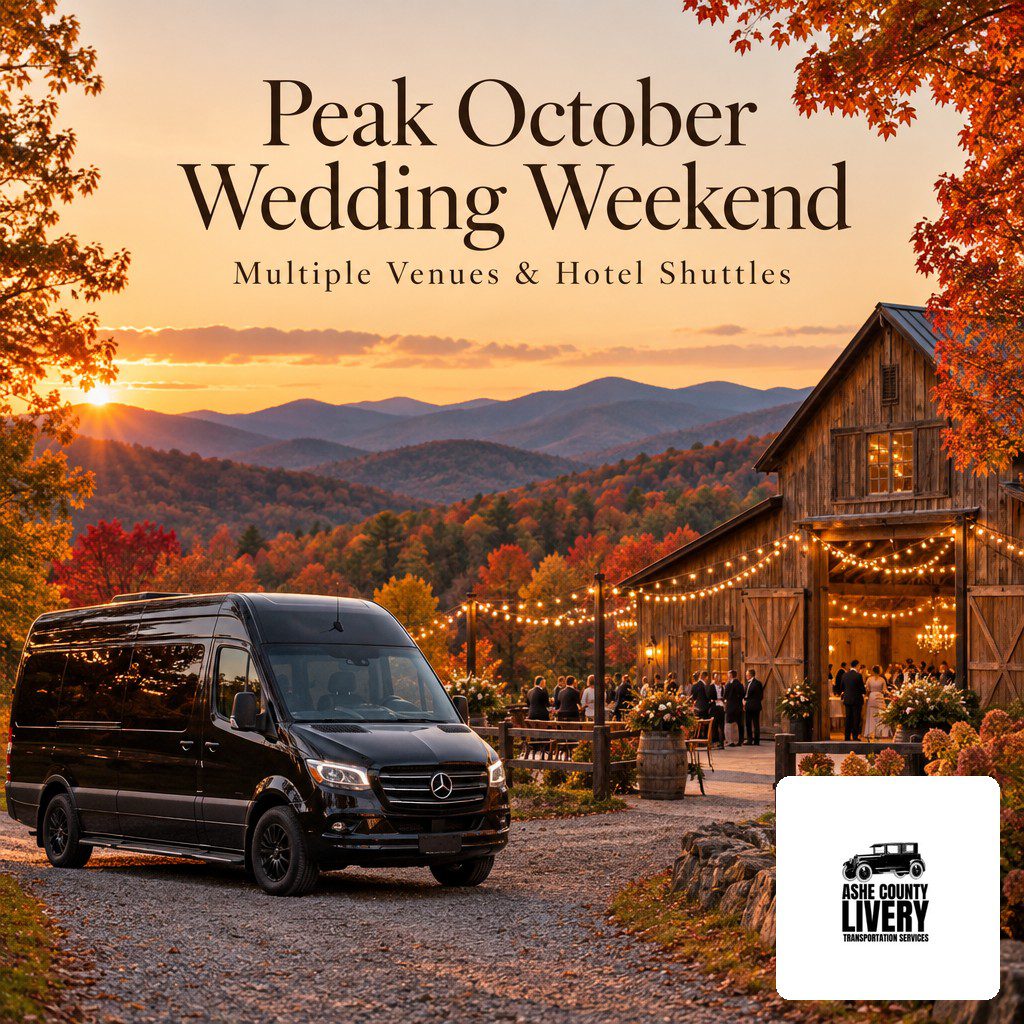
    Peak October Wedding Weekend: Managing Multiple Venues and Hotel Shuttles

    Peak October wedding weekend in the NC High Country is unlike any other time of year. Leaves are at full color, every inn from Blowing Rock to Banner Elk is booked, and your guests are probably spread across three or four hotels in two or three towns. Add a ceremony at one venue, a reception at another, and a rehearsal dinner somewhere else, and transportation becomes the piece that holds the whole weekend together.

    This guide walks through how to plan multi-venue wedding transportation and hotel shuttles for an October mountain wedding, so your guests arrive on time, relaxed, and ready to celebrate.

    Why October Weekends Are Different in the High Country

    October is the busiest month of the year in Watauga, Avery, and Ashe counties. That matters for your wedding in a few specific ways:

    • Traffic is heavy. Leaf-season visitors pack US-321 between Boone and Blowing Rock, NC-105 toward Linville, and the Blue Ridge Parkway on Saturday afternoons. A 20-minute drive can easily take 45.
    • Hotels are scattered. Room blocks fill early, so guests often end up split between Boone, Blowing Rock, Banner Elk, and West Jefferson.
    • Parking is scarce. Many mountain venues have limited parking on gravel lots or narrow drives, and October crowds make it worse.
    • Daylight is shorter. Sunset arrives around 7:00 PM in early October and closer to 6:40 PM by the end of the month, so late-night returns happen in full dark on winding roads.

    Planning for all four ahead of time keeps the weekend from turning into a scramble.

    Mapping Your Multi-Venue Wedding Weekend

    Start by listing every location your guests need to reach and when. A typical October weekend might look like this:

    1. Friday evening: Rehearsal dinner in downtown Blowing Rock
    2. Saturday afternoon: Ceremony at an overlook or chapel, such as a mountaintop site near Banner Elk
    3. Saturday evening: Reception at a resort like Chetola Resort or a barn venue like Overlook Barn
    4. Sunday morning: Farewell brunch, then airport departures to CLT, GSO, or TRI

    Next, list each hotel in your room blocks and roughly how many guests are staying at each. This gives you a simple grid of pickup points and destinations, which is exactly what your transportation company needs to build a route.

    Group Hotels Into Pickup Zones

    If guests are spread across six properties, you don’t need six separate pickups. Group nearby hotels into zones. For example:

    • Boone zone: hotels along Blowing Rock Road and downtown King Street
    • Blowing Rock zone: Main Street inns and Chetola Resort
    • Banner Elk zone: lodges and rentals near NC-184 and Beech and Sugar Mountain

    Ask guests to meet at one central lobby per zone. Fewer stops mean shorter routes and fewer chances for someone to miss the ride.

    Hotel Shuttle Strategies That Work in the Mountains

    Staggered Departures

    For a 100-guest wedding with three hotel zones, plan staggered departures 15-20 minutes apart so every group arrives at the ceremony 20-30 minutes before it starts. That buffer absorbs leaf-season traffic and gives guests time to find their seats.

    Rolling Return Loops

    Not everyone wants to leave the reception at the same time. Rolling loops, with a Sprinter van leaving every 45-60 minutes after dinner, let older guests and families with kids head back early while the dance floor keeps going. Schedule a final departure 15 minutes after the last song.

    Venue-to-Venue Transfers

    When the ceremony and reception are at different locations, a single shuttle run between them is the easiest way to keep everyone together. It also means no one has to navigate an unfamiliar mountain road in the dark after a glass of champagne.

    Timing Tips for Peak October Weekends

    • Add 50% to normal drive times on Saturday between 11 AM and 5 PM.
    • Avoid the Parkway for timed routes. It’s beautiful, but slow traffic and pull-offs make it unreliable for a ceremony deadline.
    • Check local events. App State home football games in Boone and the Woolly Worm Festival in Banner Elk (third weekend of October) bring big crowds.
    • Plan photo stops separately. If the couple wants golden-hour portraits at an overlook, book a separate luxury SUV so the guest schedule stays on track.

    Communicating the Plan to Guests

    Even a perfect shuttle schedule fails if guests don’t know about it. Include transportation details in three places:

    1. Your wedding website, with a simple table of pickup times by hotel zone
    2. A printed card in welcome bags at each hotel
    3. A reminder text the morning of the wedding

    Name a point person, such as a planner or a reliable friend, who has the driver’s contact information and can answer questions on the day.

    Book October Transportation Early

    October dates for the following year often book 9-12 months ahead in the High Country. If you’re planning a fall wedding, reserve transportation as soon as your venues are confirmed. Ashe County Livery runs luxury shuttles, Sprinter vans, and executive SUVs throughout Boone, Blowing Rock, Banner Elk, West Jefferson, and the surrounding mountains, with local drivers who know these roads after dark.

    Request a quote for your October wedding weekend or call (336) 484-1350 to talk through your venues and hotel blocks.

    Frequently Asked Questions

    How many shuttles do I need for a multi-venue wedding?

    It depends on guest count, number of hotel zones, and how spread out your venues are. Many 80-120 guest weddings work well with two vehicles running staggered loops. A quick call with your guest list and venue addresses is the fastest way to get an accurate plan.

    Should the shuttle stop at every hotel?

    Usually not. Grouping hotels into two or three pickup zones keeps routes short and reliable, especially during October traffic.

    Can you handle Sunday airport transfers too?

    Yes. Many couples add Sunday departures to Charlotte (CLT), Greensboro (GSO), or Tri-Cities (TRI) so out-of-town guests have an easy ride home.

    How early should we book for an October wedding?

    As early as possible. Peak October Saturdays are the first dates to fill, often close to a year in advance.

  • Peak Foliage Week: When and Where to See the Best Color in the High Country

    Peak Foliage Week: When and Where to See the Best Color in the High Country

    Peak fall foliage week in the NC High Country is short, spectacular, and unforgiving on a schedule. Elevation swings from 3,300 feet in Boone to over 5,900 feet on Grandfather Mountain mean the color doesn’t arrive all at once — it rolls downhill over about three weeks, and timing your visit to the wrong week can mean driving two hours to see mostly green trees. Here’s when and where the color actually peaks, and how to get there without losing half your day to Blue Ridge Parkway traffic.

    When Peak Color Actually Hits Each Elevation

    Fall color doesn’t move at random — it follows elevation and first-frost timing almost like clockwork:

    • Above 5,000 feet (Grandfather Mountain, Beech Mountain, Elk Knob): peaks in the first two weeks of October, sometimes as early as late September.
    • 3,500–5,000 feet (Blowing Rock, Banner Elk, most of the Blue Ridge Parkway around Boone): typically peaks mid-to-late October.
    • Below 3,500 feet (West Jefferson, the Yadkin Valley foothills, Wilkesboro): holds color into late October and even early November.

    That gradient is actually good news for visitors — if you miss peak at one elevation, you can chase it downhill and still catch vivid color for another two to three weeks.

    Where to See the Best Color

    Blue Ridge Parkway (Milepost 292–305, near Blowing Rock)

    This stretch offers some of the most photographed overlooks in the entire High Country, including Rough Ridge and the Linn Cove Viaduct wrapping around Grandfather Mountain. Parking fills before 9 a.m. on peak-color weekends, and the Parkway itself frequently closes sections for congestion — one more reason a shuttle beats a line of cars searching for a spot.

    Grandfather Mountain

    The Mile-High Swinging Bridge and the mile-high overlooks give a panoramic view across multiple counties at once, so you can see several elevation bands changing color simultaneously. Entry is timed on busy fall weekends, so arriving with a scheduled pickup rather than hunting for parking saves real time.

    Valle Crucis and the Watauga River Valley

    Quieter than the Parkway but just as vivid, with river reflections adding another layer of color. It’s an easy add-on to a Boone or Banner Elk day without backtracking through Parkway traffic.

    West Jefferson and the Ashe County Backroads

    Lower elevation means later peak color and open farmland views that contrast nicely with the ridge-top forest. West Jefferson also makes a natural stop for a foliage-and-wine day — several Yadkin Valley wineries are a short drive from here once you’re back down in elevation.

    Why Foliage-Week Traffic Is Different From a Normal Weekend

    Peak weeks bring visitors from Charlotte, the Triad, and beyond who are all trying to hit the same three or four overlooks between 10 a.m. and 3 p.m. The Parkway’s narrow shoulders and limited pullouts weren’t built for that volume, so what’s normally a 20-minute drive between overlooks can stretch to 45. A single vehicle running a planned loop — rather than four separate cars searching for parking at each stop — moves through those bottlenecks far more efficiently, and nobody has to sit out the views to drive.

    Planning Your Peak Foliage Day

    1. Check elevation before you check the calendar. “Peak week” for Boone is not peak week for West Jefferson — plan your route around the elevation band that’s changing that week.
    2. Start early. Overlooks that are empty at 8 a.m. are gridlocked by 10.
    3. Build in a downhill contingency. If the ridge tops are past peak or fogged in, having a lower-elevation stop ready (Valle Crucis, West Jefferson) salvages the day.
    4. Book your ride in advance. Foliage weekends are the highest-demand weekends of the year for High Country transportation — plan ahead rather than calling the week of.

    Let Someone Else Watch the Road

    A private shuttle means everyone in your group can watch the color instead of the double yellow line, and your driver already knows which overlooks are worth the stop and which parking areas fill up first. Ashe County Livery runs custom foliage-week routes connecting the Parkway, Grandfather Mountain, and the Yadkin Valley foothills in one seamless day — no circling for parking, no missed overlooks. Book your foliage tour transportation before the peak-week calendar fills up.

    Frequently Asked Questions

    When is peak fall foliage in the NC High Country?

    Higher elevations (Grandfather Mountain, Beech Mountain) typically peak in early-to-mid October, while lower elevations (West Jefferson, the Yadkin Valley foothills) peak in late October.

    What’s the best overlook for fall color on the Blue Ridge Parkway?

    The stretch between milepost 292 and 305 near Blowing Rock, including Rough Ridge and the Linn Cove Viaduct, is widely considered the most scenic and most photographed section in the area.

    Should I drive myself during peak foliage week?

    You can, but expect slow traffic, full parking lots, and Parkway congestion during midday hours. A private shuttle lets your group enjoy the views without the stress of driving and parking at each stop.

    Can I combine a foliage tour with a wine tour?

    Yes — lower-elevation foliage around West Jefferson pairs naturally with a Yadkin Valley wine tour, since both sit at a similar elevation and are a short drive apart.

  • Yadkin Valley Wine and Fall Foliage: The Ultimate Autumn Day Trip

    Yadkin Valley Wine and Fall Foliage: The Ultimate Autumn Day Trip

    Yadkin Valley wine and fall foliage were made for each other, and the last two weeks of September through mid-October is the sweet spot when both peak at the same time. The rolling hills of the Yadkin Valley American Viticultural Area sit at a lower elevation than Boone or Blowing Rock, so while the High Country is already deep into leaf season, the valley below is still finishing its harvest — which means you can chase color on the drive down and taste wine made from grapes picked that same week.

    The catch is logistics. A proper Yadkin Valley day trip means visiting three or four wineries spread across two counties, on winding two-lane roads that get busy with leaf-peepers and harvest traffic. Add wine tastings into the mix and self-driving stops being the smart option. This guide lays out the best autumn route through the valley and why a private shuttle makes the day easier — and safer — for everyone in the car.

    Why Late September Through Mid-October Is the Sweet Spot

    Fall foliage in the NC High Country typically peaks between the second week of October (higher elevations like Grandfather Mountain and Beech Mountain) and the last week of October (lower elevations closer to the Yadkin Valley). That staggered timing is exactly why a wine-and-foliage day trip works so well right now: you get golden ridgelines on the drive down from Ashe or Watauga County, then valley color still building around the vineyards themselves.

    It’s also harvest season. Most Yadkin Valley wineries wrap up picking Cabernet Franc, Chambourcin, and Viognier grapes by early October, and several host crush-season tastings, barrel samples, and harvest-themed menus through the month. Visiting now means fresher pours and a working vineyard to look at, not just a tasting room.

    Building the Route: A Sample Autumn Day Trip

    A well-planned day covers three wineries comfortably, with time for lunch and photos, without anyone feeling rushed between tastings. A typical itinerary looks like this:

    • 10:00 AM — Pickup: Departure from Boone, West Jefferson, or a mountain hotel, heading south into the valley.
    • 11:00 AM — First winery: An estate known for its Cabernet Franc and vineyard views, ideal for a relaxed first tasting while everyone settles in.
    • 12:30 PM — Lunch stop: Many wineries in the region offer a food pairing menu or wood-fired pizza on weekends, perfect for a mid-day break.
    • 2:00 PM — Second winery: A larger estate with a broader flight and outdoor seating overlooking the vines — great for the golden early-afternoon light.
    • 3:30 PM — Third winery: A smaller, family-run vineyard for a quieter finish to the tasting portion of the day.
    • 5:00 PM — Return drive: Heading back north as the light turns golden over the foothills — often the best photo window of the whole day.

    That schedule covers roughly 60-90 miles of round-trip driving, on top of local roads between tasting rooms, which is exactly the kind of day where a driver who already knows the route pays for itself in relaxation alone.

    Why a Private Shuttle Beats Self-Driving This Time of Year

    Three reasons stand out for an autumn wine-and-foliage day specifically:

    • Everyone gets to taste. With multiple tastings across the day, no one wants to be the sober designated driver navigating unfamiliar back roads.
    • Fall traffic is heavier than summer. Leaf-peeper traffic on the parkway and connecting highways slows the drive down, and a driver who has run the route before knows which turns and pull-offs to expect.
    • Photo stops don’t cost you anything. When a ridge lights up gold on the drive between wineries, your driver can simply pull over for two minutes instead of you weighing whether it’s worth the detour.

    A luxury SUV or executive shuttle van also means the group stays together for the whole day instead of splitting into multiple cars and losing each other between stops — a common problem on a multi-winery route with spotty cell service in the valley.

    Tips for Planning Your Autumn Winery Day Trip

    1. Book your transportation first, then build the winery list around it. Weekend afternoons in October fill fast for both wineries and shuttle service.
    2. Cap it at three or four wineries. More than that turns the day into a rushed checklist instead of an actual wine tour.
    3. Call ahead for reservations. Fall weekends bring larger crowds, and several wineries require reservations for groups of six or more.
    4. Pack a light jacket. Valley mornings can start cool even when the afternoon warms up nicely — layer for the temperature swing.
    5. Leave room for the drive itself. Some of the best foliage of the day is on the road, not at the tasting room, so build in time to actually enjoy it.

    Frequently Asked Questions

    How many wineries can we realistically visit in one day?

    Three is comfortable, four is doable if the wineries are close together and tastings run efficiently. Trying to fit in five or more usually means rushing through pours and missing the point of the trip.

    Is early October or late October better for foliage in the Yadkin Valley?

    Lower elevations like the Yadkin Valley typically peak later than the High Country — think mid-to-late October — so pairing a High Country departure with a valley wine day in that window often catches color in both places.

    Do we need to book winery reservations in advance for a fall day trip?

    Yes, especially for weekend dates in October. Many tasting rooms limit walk-in group size during harvest season, so call ahead once your date and route are set.

    What’s included with a private wine tour shuttle?

    A dedicated driver, a comfortable luxury SUV or shuttle van for your group, and a flexible schedule built around your chosen wineries — no one has to worry about driving between tastings.

    Ready to plan your Yadkin Valley wine and fall foliage day trip? Book your private shuttle with Ashe County Livery and let a local driver handle the route while you enjoy the harvest season pours and the color on the drive. Call us at (336) 484-1350 to talk through your itinerary.

    Related reading

  • Cozy Fall Wedding Transportation: Planning for Chilly Mountain Evenings

    Cozy Fall Wedding Transportation: Planning for Chilly Mountain Evenings

    As autumn deepens across the High Country, the region’s wedding calendar shifts from long, golden evenings to shorter days and a real chill after sunset. Cozy fall wedding transportation planning looks different than it does in June — your shuttle schedule has to account for temperatures that can drop into the 40s by 8 PM, earlier darkness on mountain roads, and guests who need a warm, comfortable ride between ceremony, reception, and their lodging. Here’s how to plan transportation that keeps everyone comfortable when the mountain evenings turn chilly.

    Why Fall Evenings Change Your Transportation Plan

    Elevation makes a real difference in the High Country. A wedding at 3,500 feet in Boone or Banner Elk can be 10-15 degrees cooler after dark than the forecast for Charlotte or Winston-Salem. By late October, sunset arrives before 7 PM and temperatures often fall into the 40s well before the reception ends. That combination means:

    • Earlier pickup windows — guests waiting outside a venue for a shuttle in 45-degree air for even ten minutes feel it, especially in formalwear
    • Heated cabins matter — our Mercedes Sprinter vans and Transit shuttles run heat continuously during loading, not just once the doors close
    • Shorter daylight for photos — golden hour shoots and vineyard-backdrop portraits need to be scheduled and shuttled around a compressed window
    • Road conditions — mountain roads like NC-105, US-321, and the Blue Ridge Parkway can have patchy fog or frost by late October, so experienced local drivers matter more than in summer

    Building a Cold-Weather Wedding Day Timeline

    A typical fall wedding at a venue like Chetola Resort in Blowing Rock or Overlook Barn near Banner Elk needs a timeline that front-loads outdoor moments into the warmer afternoon hours and reserves heated shuttles for anything after dusk. A sample cold-weather timeline:

    • 2:00 PM — Wedding party shuttle from getting-ready location to ceremony venue (heat on, doors closed quickly)
    • 3:30 PM — Ceremony, while afternoon sun is still warm
    • 4:15 PM — Guest shuttle loop begins for cocktail hour photos, minimizing outdoor wait time
    • 5:30 PM — Reception begins as temperatures start dropping
    • 9:30 PM–11:00 PM — Return shuttle loops to hotels in Boone, Blowing Rock, or Banner Elk, running continuously so no one waits outside in the cold

    Because darkness falls earlier in October and November, we recommend scheduling any outdoor cocktail hour or photo sessions to wrap by 5:30 PM and shifting return shuttle loops about an hour earlier than a summer wedding would need.

    What to Look for in a Fall Wedding Shuttle Service

    Heated, Enclosed Vehicles

    This sounds obvious, but not every transportation option in the region runs true climate control. Our fleet — Mercedes Sprinter vans, Ford Transits, a GLS 450 SUV, and an Audi Q5 — keeps cabins warm from the moment guests step in, which matters most for guests in cocktail dresses or thin suits who came from a warmer part of the state.

    Drivers Who Know Mountain Roads After Dark

    Roads like the Blue Ridge Parkway, Beech Mountain Parkway, and the switchbacks around Valle Crucis behave differently at night in fall — reduced visibility, wildlife activity, and occasional early frost on shaded curves. Local, experienced drivers who know these routes are far more valuable in October than in July.

    Flexible, Rolling Pickup Loops

    Rather than one single shuttle run, a continuous loop between the venue and nearby hotels means no guest stands outside waiting more than a few minutes. This is especially important for older guests and anyone in formalwear without a coat.

    Buffer Time Built Into the Schedule

    Fall weekends near App State home games or leaf-peeper traffic on US-321 and NC-105 can add unpredictable delays. Building a 15-20 minute buffer into every shuttle leg keeps the night running smoothly even if traffic is heavier than expected.

    Cozy Touches That Make a Cold-Weather Shuttle Feel Special

    • Stock each vehicle with a few blankets for guests moving between an outdoor ceremony and an indoor reception
    • Coordinate with your planner to have warm cider or hot chocolate waiting at the reception entrance after the shuttle ride
    • Ask your driver to keep interior lighting warm and low rather than bright overheads, matching the evening’s mood
    • If your ceremony is outdoors, keep the shuttle running nearby with the heat on so guests can step back in immediately after

    Planning Tips for Late Fall Weddings in the High Country

    1. Book your shuttle 4-6 months ahead. Fall remains our busiest season and vehicles for October and November weekends go quickly.
    2. Share your full weekend itinerary early, including rehearsal dinner and next-morning airport departures, so we can plan one coordinated transportation plan instead of piecing it together last minute.
    3. Confirm venue-specific pickup and drop-off points — some High Country venues, like properties near Beech Mountain or Valle Crucis, have limited parking and require a dedicated shuttle loop rather than guest self-parking.
    4. Ask about a warm-up stop if your wedding involves an outdoor ceremony followed by an indoor reception at a different location.

    Ready to plan cozy, comfortable transportation for your fall or winter High Country wedding? Book your wedding transportation with Ashe County Livery and let us build a timeline that keeps your guests warm from ceremony to last dance.

    Frequently Asked Questions

    How much colder does it get in the High Country compared to lower-elevation NC cities?

    Towns like Boone, Blowing Rock, and Banner Elk sit at 3,000-4,000+ feet, which typically runs 10-15 degrees cooler than Charlotte or Winston-Salem, especially after sunset. Fall evenings can dip into the 40s even when the daytime high was comfortable.

    Do you provide heated vehicles for fall and winter weddings?

    Yes. Our Mercedes Sprinter vans, Transit shuttles, GLS 450, and Audi Q5 all run full climate control, and drivers keep the heat running during guest loading, not just once doors are closed.

    How early should we schedule return shuttles for a fall wedding?

    We recommend shifting return shuttle loops about an hour earlier than you would for a summer wedding, since darkness and dropping temperatures arrive sooner. Continuous rolling loops work best so guests never wait outside.

    Can you coordinate transportation for a rehearsal dinner and next-day airport departures too?

    Absolutely — sharing your full weekend itinerary lets us build one coordinated plan covering rehearsal dinner transportation, wedding day shuttles, and next-morning airport transfers to CLT, GSO, or TRI.

    Related reading

  • Best Apple Orchards and Fall Festivals Near Boone: A Family Day Trip Guide

    Best Apple Orchards and Fall Festivals Near Boone: A Family Day Trip Guide

    When the first cool mornings settle over the High Country and the maples along US-321 start turning gold, families across North Carolina start planning their fall day trips. Boone sits at the center of some of the best apple orchards and fall festivals near Boone, all within a short drive of downtown — but the same roads that make the area beautiful in October also make it crowded, with narrow mountain lanes, tight orchard parking lots, and festival traffic that can turn a simple outing into an hour of circling for a parking spot.

    This guide covers the best orchards and festivals near Boone for a family day trip, what to expect from crowds and parking, and how a private shuttle or luxury SUV takes the stress out of getting the whole group there and back — no one arguing over who’s driving, no one missing the fun because they’re stuck watching for a parking spot to open up.

    Best Apple Orchards Near Boone

    The High Country’s elevation and cool nights make it excellent apple-growing country, and several family-run orchards within 20-30 minutes of downtown Boone open their doors for u-pick season every September and October.

    Apple Hill Orchard & Cider Mill (Morganton area)

    A bit further south, Apple Hill draws High Country families for u-pick apples, fresh-pressed cider, and a bakery counter that sells out of cider donuts most fall weekends. Parking is on grass fields that get soft and slow after rain, and the lot fills by mid-morning on peak Saturdays.

    Champion Hills and Orchard at Altapass (Blue Ridge Parkway, Little Switzerland)

    The Orchard at Altapass, at Milepost 328.3 on the Blue Ridge Parkway, is one of the region’s most beloved fall stops — live music on the porch, apple butter making, and orchard tours through century-old trees. It’s about an hour from Boone via the Parkway, which is stunning in leaf season but slow going with RVs and photo-stop traffic. Parking is limited to a gravel lot that overflows onto the roadside on weekends.

    Local orchards around Ashe and Watauga County

    Closer to home, several smaller family orchards around West Jefferson and the Beaver Creek area sell apples, cider, and pumpkins straight from the farm stand. These spots don’t always have paved parking, and turning a full-size vehicle around in a farm driveway is its own challenge — one more reason families are booking a shuttle rather than caravanning in separate cars.

    Best Fall Festivals Near Boone

    Fall festival season in the High Country runs from mid-September through the end of October, and several events draw large crowds from across the region.

    Valle Crucis Community Fair

    Held each October at the Valle Crucis Elementary School fields, this fair brings together local crafts, farm animals, live bluegrass, and a full slate of fall food vendors. It’s a short, scenic drive from Boone down NC-194, but parking is on grass fields that fill fast and close once they’re full — arriving as a family group of six in one shuttle beats hunting for two or three separate spots.

    Woolly Worm Festival (Banner Elk)

    One of the region’s most famous fall events, the Woolly Worm Festival takes over downtown Banner Elk in mid-October with the town’s legendary woolly worm races (used to “predict” the coming winter), plus live music, food trucks, and craft vendors lining the streets. Downtown Banner Elk closes to through-traffic during the festival, street parking disappears within the first hour, and the walk in from any overflow lot can be 15-20 minutes each way — tough with young kids or grandparents in the group.

    App State Home Games and Downtown Boone Saturdays

    Fall in Boone also means App State football Saturdays, which pack downtown restaurants and King Street with fans before and after kickoff. Families combining an orchard trip with a Saturday downtown Boone visit often find that traffic around Rivers Street and King Street adds 20-30 minutes to what should be a five-minute crosstown drive.

    West Jefferson Fall Markets

    West Jefferson’s murals and small-town Main Street host fall pop-up markets and a pumpkin-themed weekend each October, drawing day-trippers from Boone, Blowing Rock, and beyond. Main Street parking is limited to a few small municipal lots, and festival weekends see them full by 10 a.m.

    Sample Family Day Trip Itinerary

    A popular combination for families visiting the High Country in October:

    • 9:00 a.m. — Pickup from your Boone hotel, cabin, or Airbnb in a private shuttle
    • 9:30 a.m. — Arrive at a local orchard for u-pick apples and cider donuts
    • 11:30 a.m. — Drive the Blue Ridge Parkway toward Little Switzerland for foliage views and a stop at the Orchard at Altapass
    • 1:30 p.m. — Lunch in Blowing Rock or Banner Elk
    • 3:00 p.m. — Woolly Worm Festival or a downtown Boone stroll, depending on the weekend
    • 6:00 p.m. — Return shuttle back to your lodging

    Trying to drive this route yourself means someone stays sober and alert through a full day of mountain curves, and someone has to solve the parking puzzle at every single stop. A private shuttle removes both problems: your driver handles the roads and the parking search while everyone else enjoys the apples, the music, and the views.

    Why Book Transportation for Fall Orchard and Festival Trips

    • Parking is genuinely limited. Grass lots, gravel lots, and small municipal lots fill fast on fall weekends, and a shuttle can often drop passengers closer to the entrance than where a car would end up parking.
    • Mountain roads deserve full attention. The Blue Ridge Parkway and routes like NC-194 and NC-105 are narrow and winding, with slow-moving leaf-peeper traffic in October. Let a local driver who knows the roads handle it.
    • Multi-generation groups travel together. One shuttle keeps grandparents, parents, and kids in the same vehicle instead of splitting into a caravan that gets separated in festival traffic.
    • You can enjoy cider (or a festival beer) without worrying about the drive home.

    Ashe County Livery runs private shuttles and luxury SUVs throughout the High Country for exactly these kinds of family day trips — orchard hopping, festival weekends, and game-day visits to Boone. If you’re planning a fall outing with family or friends, book your transportation before the peak weekends fill up.

    Frequently Asked Questions

    What’s the best month to visit apple orchards near Boone?

    Late September through mid-October is peak apple season in the High Country, with the best combination of ripe fruit and turning leaves. Weekends in early-to-mid October are the busiest for both orchards and festivals.

    Do I need reservations for orchard visits?

    Most u-pick orchards don’t require reservations, but some limit daily visitor numbers on peak weekends, so it’s worth checking ahead. Transportation reservations should be made at least 1-2 weeks in advance for October weekends, since fall is one of the busiest seasons for shuttle bookings in the region.

    How far are the orchards and festivals from downtown Boone?

    Most are within 20-45 minutes of downtown Boone. The Orchard at Altapass is about an hour via the Blue Ridge Parkway, while Valle Crucis and Banner Elk are 20-30 minutes.

    Can a shuttle handle multiple stops in one day?

    Yes — a private shuttle day trip is exactly how families combine an orchard visit, a festival stop, and lunch in one outing without worrying about parking or driving between each stop. Ashe County Livery can build a custom multi-stop itinerary for your group.

    Related reading